
Wire Drawing Process Explained: From Steel Rod to Finished Wire
Wire drawing is one of the most important processes in the wire manufacturing industry. It transforms thick steel rods into thinner wires with precise diameters, smooth surfaces, and consistent mechanical properties. These wires are widely used in construction, automotive components, fasteners, fencing, electrical applications, and wire nail manufacturing.
Understanding the wire drawing process helps manufacturers improve product quality, optimize production efficiency, and reduce material waste.
1. What Is the Wire Drawing Process?
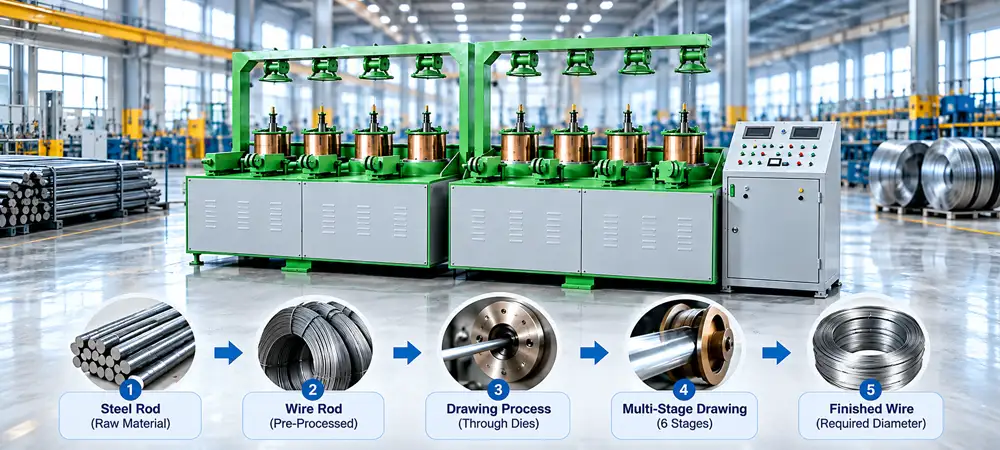
Wire drawing is a metalworking process in which a steel rod or wire is pulled through a specially designed tool called a drawing die. The die reduces the wire’s diameter while increasing its length.
Depending on the required final diameter and material properties, the wire may pass through multiple dies in sequence.
The process helps manufacturers produce wires with uniform dimensions and the strength characteristics required for different applications.
2. Step-by-Step Wire Drawing Process
Step 1: Selection of Raw Steel Rod
The process begins with selecting suitable steel wire rods based on the intended application and final wire specifications.
Important factors include steel grade, carbon content, initial diameter, surface condition, and mechanical properties.
Using appropriate raw material helps achieve consistent drawing performance and reduces the risk of wire breakage during production.
Step 2: Surface Cleaning and Preparation
Before drawing, the steel rod must be prepared to remove scale, rust, and other surface contaminants.
Common preparation methods include mechanical descaling, such as wire brushing or shot blasting, and chemical pickling where appropriate.
After cleaning, a suitable lubricant or coating may be applied to improve drawing conditions and reduce friction between the wire and the die.
Proper surface preparation helps improve wire quality and extend die service life.
Step 3: Pointing the Wire
The end of the steel rod is reduced in diameter during a process known as pointing.
This narrower end allows the operator or feeding system to guide the wire through the drawing die and connect it to the drawing mechanism.
Pointing is an important preparation step, particularly when starting a new drawing operation or changing material coils.
Step 4: Drawing the Wire Through Dies
The prepared steel rod is pulled through a drawing die that reduces its diameter to the required size.
The die applies compressive deformation as the wire passes through its opening. The pulling force is provided by the drawing machine.
For larger diameter reductions, the wire typically passes through multiple dies, with each die reducing its cross-section progressively.
The selection of die geometry, reduction per pass, drawing speed, and lubrication conditions plays a major role in achieving consistent results.
Step 5: Lubrication and Cooling
Friction between the wire and the die generates heat during drawing. Effective lubrication helps control friction, reduce die wear, and improve the surface finish.
Depending on the machine and production process, manufacturers may use dry drawing lubricants or wet drawing systems.
Cooling arrangements may also be used to manage operating temperatures and protect equipment components.
Proper lubrication and temperature control help maintain stable production and reduce the likelihood of surface defects or wire breakage.
Step 6: Intermediate Annealing, If Required
Cold drawing increases the strength and hardness of steel wire but can also reduce its ductility. This effect is known as work hardening.
For some steel grades and applications, intermediate annealing may be necessary to restore ductility before further drawing.
Whether annealing is required depends on the material composition, total reduction, drawing schedule, and final product requirements.
Step 7: Final Sizing and Surface Inspection
After reaching the required diameter, the wire is inspected to confirm that it meets the specified dimensional and quality requirements.
Typical quality checks include:
– Wire diameter and dimensional consistency
– Surface finish and visible defects
– Tensile strength and elongation, where specified
– Straightness or coil condition, as applicable
– Compliance with relevant customer or industry specifications
Consistent inspection helps ensure that the finished wire is suitable for its intended manufacturing application.
Step 8: Coiling and Packaging
Once the wire meets the required specifications, it is collected into coils or other suitable packaging formats.
The finished wire is labelled and stored according to its grade, diameter, batch number, and customer requirements.
Proper packaging and handling help prevent contamination, corrosion, tangling, and surface damage during storage and transportation.
3. Types of Wire Drawing Machines
Different wire drawing machines are used depending on the material, wire diameter, production volume, and required output quality.
Single-Block Wire Drawing Machine
A single-block machine draws wire through one primary drawing block and is generally used for suitable applications involving limited drawing stages or specific production requirements.
Multi-Block Wire Drawing Machine
A multi-block machine draws wire through several dies and blocks in sequence. It is commonly used when greater diameter reduction and continuous production are required.
Wet Wire Drawing Machine
Wet drawing machines use liquid lubricants and cooling media during the drawing process. They are often selected for fine-wire production and applications requiring effective friction and temperature control.
Dry Wire Drawing Machine
Dry drawing machines generally use solid lubricants and are commonly used for suitable medium- and larger-diameter wire applications.
The right machine depends on the steel grade, target wire diameter, production requirements, and process conditions.
4. Common Challenges in the Wire Drawing Process
Although wire drawing is an established manufacturing technique, several production challenges can affect quality and efficiency.
Wire Breakage: Excessive reduction per pass, unsuitable material properties, poor lubrication, or incorrect machine settings may contribute to wire breakage.
Surface Defects: Scale, contamination, damaged dies, and inadequate lubrication can affect the surface quality of the finished wire.
Inconsistent Diameter: Worn dies, unstable drawing conditions, and incorrect process settings can cause dimensional variations.
Excessive Die Wear: High friction, poor lubrication, and unsuitable operating conditions may shorten die life and increase maintenance costs.
Reduced Ductility: Excessive cold work can make the wire harder and less ductile, potentially requiring an appropriate annealing process.
Regular equipment maintenance, correct die selection, material inspection, and process monitoring can help address these challenges.
5. Benefits of an Efficient Wire Drawing Process
An efficient wire drawing process offers several advantages for wire manufacturers.
– Precise Diameter Control: Helps produce wire that meets required dimensional tolerances.
– Improved Surface Quality: Appropriate cleaning, lubrication, and tooling help achieve a consistent finish.
– Enhanced Mechanical Properties: Cold drawing can increase strength and hardness, depending on the material and process.
– Better Production Efficiency: Optimized drawing stages and machine settings can reduce unnecessary downtime.
– Reduced Material Waste: Proper process control helps minimize breakage and rejected wire.
– Versatile Applications: Drawn wire can be manufactured for nails, fasteners, fencing, construction, and other industrial uses.
6. Applications of Drawn Steel Wire
Drawn steel wire is an essential raw material for many manufacturing industries.
Wire Nail Manufacturing: Steel wire is drawn to the required diameter before being processed into nails using a nail making machine.
Construction Industry: Suitable drawn wires are used in binding wire, mesh, and other construction-related products.
Fencing and Wire Products: Drawn wire is used in manufacturing fencing materials, wire mesh, and related products.
Automotive and Engineering: Specific wire grades are used for springs, fasteners, and engineered components.
Industrial Manufacturing: Drawn wire serves as a raw material for a wide range of products that require controlled dimensions and mechanical properties.
The final wire specifications must match the performance and quality requirements of the intended application.
7. How to Improve Wire Drawing Efficiency
Manufacturers can improve wire drawing performance by focusing on process control and preventive maintenance.
– Select the correct steel grade and incoming wire rod specifications.
– Clean and prepare the rod properly before drawing.
– Use suitable drawing dies and replace worn tooling on time.
– Maintain the recommended lubrication conditions.
– Optimize reduction ratios and drawing speeds for the material.
– Monitor wire diameter and surface quality during production.
– Maintain drawing blocks, bearings, drives, and other critical components.
– Train operators to identify early signs of defects and equipment problems.
These practices can help improve consistency, control operating costs, and support reliable production.
Conclusion
The wire drawing process transforms steel rods into finished wire through a series of carefully controlled manufacturing steps. From raw material selection and surface preparation to drawing, inspection, and packaging, every stage contributes to the quality and performance of the final product.
For wire manufacturers, understanding these steps is essential for selecting appropriate machinery, maintaining dimensional accuracy, minimizing production defects, and improving operational efficiency.
Whether the finished wire is intended for nail production, construction, fencing, or industrial applications, a well-managed wire drawing process helps ensure consistent and dependable results.
**Looking for reliable wire manufacturing machinery?** Connect with Indian Wire Product to discuss your production requirements and explore suitable machinery solutions for your business.

